Thursday, September 2, 2010

TALES OF THE LOST BANDANA


Romanian from the mid 20th century natural dies......

American late 1800's aka "Turkey red" no branding on this one not "color fast" .of course dry clean mandatory....

Marseille connection early 20th century on thin cotton...

Spanish probably of same origin....

American 1920's large size ....

Mexican 40's thicker than a American ....
American deco style....
Same period .....
Mid 30's deco styled of American origin..

FOUND in New Mexico 20 years ago...

50'S advertising example....
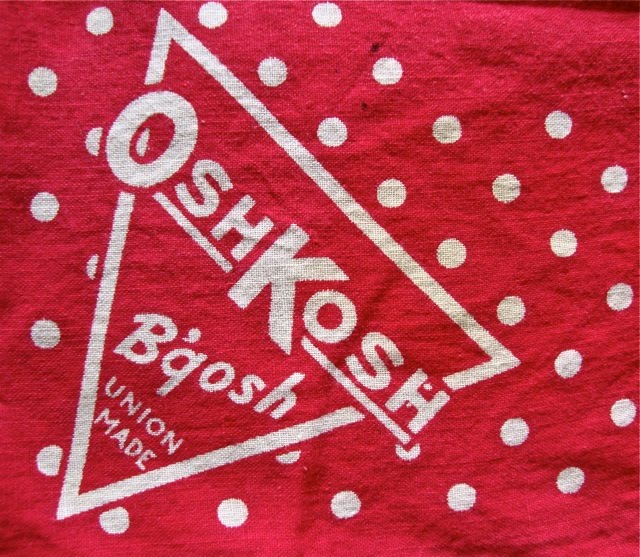
40'S work.....

Part of the ever growing collection...


As a follow up to my last post ,i've decided to talk a little bit , if i may,of what's the most recognised and widely used accessory in the world :the iconic BANDANA and it's Paisley based motif...
The name bandana comes from the Hindi"bandhana" wich means "to tie" .The name paisley, derives from the town of Paisley, in central Scotland where the motif was widely produce in the late 1800's.
The paisley pattern, is a motif resembling a twisted teardrop. The kidney-shaped paisley is of Persian and Indian origins.In the beginning the motif was weaved uniquely ,but due to its popularity the use of hand stamp for printing traditional "paisley" designs became common practice...
Paisley was first popular in the European Baltic states between 1700 and 1800 and was thought to be used as a protective charm against evil demons by the gypsies of northern Indian origins. However, in modern culture, the youth of these countries have used it as a symbol of rebellion.
the British conspiracy....
In the 19th Century European production of paisley started, particularly in the Scottish town from which the pattern takes its modern name[as mentioned above]. Soldiers returning from the colonies brought home cashmere wool shawls from India, and the" East India Company " later imported more. The design was copied from the costly silk and wool Kashmir shawls and adapted first for use on handlooms, and, after 1820 on Jacquard looms.
The "East India Company" at some point could not satisfy the increasing demand for the popular motif so,from roughly 1800 to 1850, the weavers of the town of Paisley in Renfrewshire, Scotland, became the foremost producers of the motif. The key places of manufacture for weaved or printed paisley were Britain but also the Marseille and Alsace regions of France.......
the French connection:
Local manufacturers in Marseilles began to mass-produce the patterns via early textile printing processes around 1640. England, circa 1670, and Holland, in 1678, soon followed.As a result Europe's weavers found themselves with more competition than they could bear, and the production and import of printed paisley was forbidden in France by royal decree from 1686 to 1759. However, enforcement near the end of that period was lax, and France had its own printed textile manufacturing industry in place as early at 1746.
Paisley on cotton and wool in the 19th Century was major.and by the beginning of the 20th century the paisley pattern was being printed, rather than woven, onto other textiles, including cotton squares which were the precursors of the modern bandanna. Being able to purchase printed paisley rather than woven paisley brought the price of the costly pattern down and added to its popularity.

Wednesday, September 1, 2010

THE GREAT DEPRESSION


My good friend Rochelle Baker of "mystery mister " fame here in SF ,gave me this great picture the other day .It's not so much the clothes that caught my attention ,but the little girl in the background wearing a cloche hat instead ......

Monday, August 30, 2010

"Cement Mixer" / Slim Gaillard

SALVAGED RELIC....1800's bandanna


Yesterday ,while going through an entire trunk filled with disintegrating Edwardian clothes,tucked at the bottom of it,was this beautiful indigo bandanna .Even if very fragile,it was the only thing worth picking that day.It was like opening a time capsule and as iconic in my opinion as denim.It basically puts this one as being at least late 1800's.....Anybody interested in reproducing this beauty!??Let's get in business!

Thursday, August 26, 2010

VINTAGE BLING...

My all time favorite .it's going to be hard to beat this one.solid silver with fake precious stones.one is MIA i don't know were to go for a fixing.....
Looks like :"the great Zoltar" from the fortune teller machine.....
Nice example of a solid silver novelty skull ring from the 50's....
This one is from England ,it's a victorian era solid silver pill box ,transformed into a pendant ....
I just need a cool chain for it ....


Did a post ,not so long ago ,about my modest collection of ww2 military rings,or what's left of it .I thought, it'll be interesting to showcase today, some of the other bling i wear as it might give vintage enthousiasts ,a different perspective than your over seen and way over priced mexican biker's rings ......well you tell me .

Monday, August 23, 2010

EARLY 1900'S ANKLE BOOTS

A rare color for this pair of BROWN BLUE RIBBON elkskin shoes ......

Beautiful finish for a factory made pair of boots a quick estimate places them around 1913 /1920 nicely detailed branding on the sole....

7 1/5 D dead stock pair of BLUE RIBBON their soft elk leather makes them fit like a glove.......

Straight from the archives, the first trace i was able to find , of this unusual shoe called: ELKSKIN. as advertised in a 1913 mail order catalog from Chicago.....

Another example in a 1917 Montgomery Ward catalog...

1926...same design but bulkier . little more popular perhaps !?....

1934 MW catalog....still advertised as comfort work shoes ....

Another unusual find today ,a little more "of the wall" than your average work boots from the same era....I must admit that at first ,i was a little reluctant to get them,as i thought they were more sports, than work related....silly me right !?perhaps because they were unlined and less rugged than expected for a work shoe. Then while talking to the vendor i suddenly remembered seing something similar ,in one of my earliest mail order catalog and decided to take the risk ,if any.....Well!!! lucky me,i was right .So here they're for you guys to enjoy too, a nice dead stock pair of BLUE RIBBON BROWN'S ELKSIN WORK SHOES from the early 1900's....

here's a little blab about the company's history......
In 1878 George Warren Brown, Alvin L. Bryan, and Jerome Desnoyers founded a women's shoes manufacturing company called Bryan, Brown and Company. Desnoyers retired in 1893, and the company's name was changed to Brown Shoe Company.
By 1900, the St Louis based company, had sales reaching $4 million. At that time John Bush, a Brown Shoe executive, acquired the rights to the "Buster Brown" cartoon character. This character would remain the company's signature logo for decades. The company's early marketing gimmick involved a traveling show of performers dressed as Buster Brown, the company's mascot, who put on shows in theaters, shoe stores, and department stores. Brown Shoe pioneered the idea of marketing specific shoe brands to retailers, rather than the traditional method of traveling store-to-store with samples of every shoe manufactured by the company.

Brown Shoe Company's run-ins with unions began in 1907 when the company opened its first plant outside of St. Louis in response to increased union activity in its existing urban plants. For twenty years following this, the company pursued a policy of opening factories in rural areas, where there was little to no union activity but mostly to cut the production costs . Brown Shoe began hiring women and children in 1911, as labor costs were increasing and it was legal to pay women and children less than men. More than half of the shoe workers in St. Louis were between the ages of fourteen and nineteen .Ironically, most of them,could not afford a pair of the shoes they were making .During the Depression in the 1930s, the company lowered its costs again by lowering the wages it paid to its workers.Same old story right !??......
The company was incorporated in New York in 1913, and went public on the New York Stock Exchange that same year. World War I brought a business boom to the company, as it won contracts to supply shoes to the U.S. troops. The company's second brand of shoes, Naturalizer, was introduced in 1927. Other Brown Shoe brands included Buster Brown, Brownbilt, Tread Straight, and the brand featured on today's post.....Blue Ribbon

Monday, August 16, 2010

TALKING ABOUT INFLATION....

Out of the closet where sitting for the last 13 years.....
You said inflation !?? i know they are not period perfect but compare with the price tag of your regular LVC 501....
555 Valencia plant's id #.......
Nice 1955 high rise cut ........


Another round of spring cleaning/organizing led to a new discovery.I'd actually forgotten I had these plus some others.......
These rare jeans were manufactured in the now closed Valencia Street factory as part of the Levi's Capital E vintage range, which ran from 1989 until the launch of the LVC line in 1996.they are the Levi's first attempt to reproduce the good ol'501. Levi has used the valencia st plant,which opened in November 1906,to sew certain products within its high-end vintage collection LVC . It's where the company produced replicas of the famed Nevada jeans .Every times i pass by the old plant ,i still wonder why they've sold this iconic piece of American history- . One of the very early vintage products before the brand became diluted.
So what happened during the last few years that lead to this !?? Levi's closed down ALL north American manufacturing, and laid off 2000 employees, 7 years ago in 2003. NO Levi's product has been made in the US or Canada since! that is to my humble knowledge .How ironic ,that lately,they've tried to capitalise on the old "American work force" image and the made in America concept too...
Levi's used to be made with 14.5oz Cotton and they now use 12oz cotton. The main reason for the move was the price point. Walmart would not sell Levi product until they could make it profitable for them. Till 7 years ago ,you could not buy Levi's at Walmart. For any product that Levi list at $50, Walmart wants to be able to sell it for $30 and make $15 on it. So Levi had to get their cost down to be able to whole sell a pair of jeans to Walmart at $15, so their material and productions cost on a pair of jeans is around $7 i guess. It seems that was not possible with American made 14.5 oz cotton jeans right!??.
This pair is a totally genuine rare product from my own personal collection and a collectors item in it's own right. The denim is 14 oz dark blue and quite hairy/fuzzy, and will improve dramatically with age. Inside label is stamped 555 as is top button[for Valencia st plant]. Cut is 1955.